


Welcome back to the question behind this series: does spending more on a tool make you sew better, faster, or just happier? Today it is thread snips, the little cutters that live beside the machine and get picked up forty times an hour. They are the cheapest tool I have covered, and that makes the answer interesting.
Where the series has been so far:
- Do quality tools lead to better sewing?
- Sewing scissors and the brass seam ripper
- Rotary cutters, cutting mats and tape measures
- Machine needles, pins, Wonder Clips and the bodkin
What Thread Snips Are, And Why I Own Three Pairs
A snip is not a small pair of shears. It is a dedicated thread cutter, short in the blade and meant to be grabbed without looking. Park one beside your machine and you will wonder how you managed before. The styles are not interchangeable.
Spring Loaded Snips
The squeeze type, with no finger holes at all. A flat spring holds the blades open and one press of the palm closes them. You never line your fingers up with anything, which sounds trivial until you have clipped threads for two hours. They are also kindest to arthritic hands, because the work is a squeeze rather than a grip and a spread.
Japanese Style Nigiri Snips

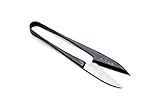
The nigiri, or U shaped snip, is one folded loop of steel with no pivot screw. The loop is the spring. They are usually forged rather than stamped, and the best come from towns that have made blades for centuries. Seki in Gifu is counted alongside Solingen and Sheffield as one of the world’s three major cutlery producing areas. In Sanjo, in Niigata, the Echigo Sanjo forged blade trade dates to the Edo period and still forge welds hard steel onto a softer iron body at around 900 degrees. Scissors have always been part of that trade.
The point is what you notice. A forged nigiri is ground very fine, so you slide under one thread rather than nibble at the tail.
Curved Tip Snips And Small Embroidery Scissors

Curved tip snips have blades that bend away from the fabric, so the point rides clear while the edge sits flat. That is how you trim flush and cut back appliqué without nicking the background.
Small embroidery scissors overlap here. Finger holes, a fine point, blades of about four inches. They cut thread beautifully but are slower to pick up. My split: embroidery scissors with the hand work, snips beside the machine. See also our guide to the 7 types of scissors for sewing.
When Your Seam Ripper Or Your Machine Is Enough
Not everybody needs to buy anything. Your seam ripper carries a small blade in the crook of the hook, and for one thread tail that is adequate. Most machines have a cutter on the head or an automatic one on a button, and for chain piecing it beats reaching for anything. Both fall down on close work: neither will trim flush to a seam or cut appliqué.
Are Expensive Thread Snips Worth It?

Here is what your money actually buys.
First, the steel and how long an edge lasts in it. Blade grades of martensitic stainless differ mainly in how much carbon they carry, from around 0.15 percent at the bottom of the range to well past one percent at the top, and carbon is what lets a blade harden enough to hold a fine edge. None of this is folklore. CATRA in Sheffield has spent fifty years building machines that measure sharpness and edge life, and the trade view is that a keener grind trades away durability. Cheap tools get that compromise wrong.
Second, and this catches everybody, how close to the tip the blades meet. Bargain snips very often cut only mid blade. Catch a thread at the point and it slides out and folds over. That single fault is the most common failure I see.
Third, on the squeeze type, the spring. A good one holds tension for years. A poor one softens, the blades sit half closed, and you lose the point of the style. Fourth, comfort. A hard edge on the loop leaves a red mark in your palm and you stop using it.
So, my verdict. Cheap snips are genuinely fine, and then one day they are not. They do not break, they quietly stop cutting cleanly, and most sewists blame the thread rather than the tool. If you sew most weeks, buy one good pair of forged Japanese style thread snips and look after them. If you sew occasionally, an ordinary spring loaded snip is plenty.
Two habits double the life of whichever you buy. Never cut paper with them, including pattern tissue and sticky labels, for the reasons in can you cut paper with your sewing scissors. Keep a deliberately cheap pair for paper, interfacing and elastic, and let it take the punishment. And know what you own: most good snips can be sharpened, most cheap ones cannot.
The Two Pairs I Would Actually Buy
Those are the two ends of my verdict and nothing in between. The forged Japanese pair is for anyone who sews most weeks and wants blades that still meet at the tip in five years. The spring loaded pair is the honest everyday choice, cheap enough to keep by the machine and good enough not to fail quietly.

More From The Tool Tips Series
Click a picture to open it, or right click and open it in a new tab to keep this page too. And do not forget to pin it.



Ready to sew? Our free sewing patterns are the perfect next stop.
How Do You Use Your Thread Snips?
Now tell me yours. Are you a squeeze snip devotee, or do you reach for the little embroidery scissors every time? Has anyone had a pair sharpened, and was it worth it? And be honest, how many pairs have quietly stopped cutting and are still in the drawer?
Some links above are Amazon affiliate links. As an Amazon Associate, So Sew Easy earns from qualifying purchases at no cost to you.
Some links on this page are affiliate links. As an Amazon Associate, So Sew Easy earns from qualifying purchases, at no extra cost to you.
Thanks so much for your comment!
It would be great if you could share this post with your friends!