


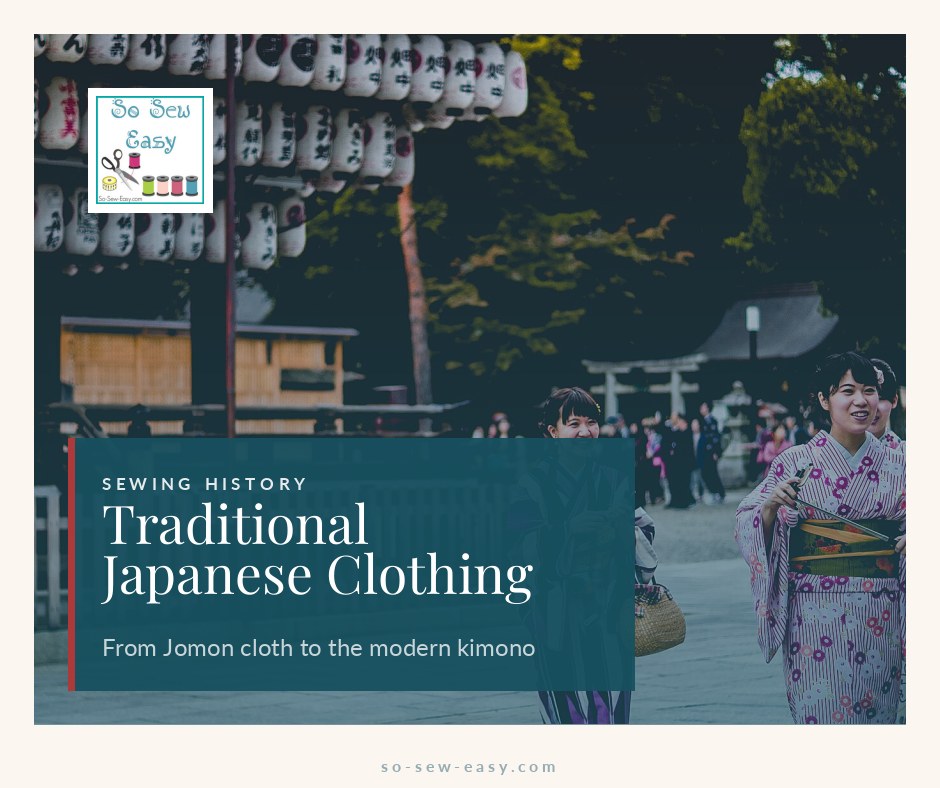
Traditional Japanese clothing looks simple from the outside and turns out to be anything but. Most of us picture a kimono and stop there, but the kimono is only the most recent chapter of a very long story.
Let us take it in order, from the first woven cloth made in Japan to the young people buying secondhand kimono today. And since this is a sewing blog, I want to dwell on how a kimono is cut.
Before The Kimono: Jomon And Yayoi
Cloth rarely survives in the ground, so the early evidence is thin. Jomon people appear to have made clothing from long narrow strips of mulberry bark, and later from cannabis sativa fibers. The oldest looms found in Japan come from a Late Jomon site in Kyushu, dated to the fourth or third century BC.
By the Yayoi period Chinese chroniclers were writing it down. The Wei Zhi records that men wrapped a single length of cloth around the body, while women wore a kantoi, a through the head garment with an opening cut for the neck. Nothing was fitted. Later, the clay figures called haniwa show crossed front jackets flaring over the hips, the ancestor of every kimono collar you will ever see.
The Nara Court Looks To China
By the seventh and eighth centuries dress was firmly two piece: a jacket called kinu with hakama trousers for men, a jacket with a skirt called mo for women. Then the court looked outward. During the Nara period, from 710 to 784, Japanese court circles adopted Chinese court dress, and in particular the long robe known in Chinese as pao. Britannica notes that emblematic colors and patterns came with the cut.
The Heian Court And The Twelve Layer Robe

When the regular missions to Tang China ended, court culture turned inward. The Heian period, 794 to 1185, gave us two great formal costumes: the sokutai for men and the junihitoe for women.
Junihitoe translates as twelve layers, though the name is approximate. Court women wore ten, twelve, fifteen or even twenty unlined silk robes at once, stacked so a narrow band of each showed at the neck, the cuff and the hem. The stacking was governed by convention. Particular combinations carried poetic names and were chosen to indicate status or identity, or to suit the season and the occasion.
The Kosode Becomes Everyday Dress

Underneath all that finery sat a plain robe with small wrist openings called the kosode, which is what the name refers to. It began as an undergarment and worked its way to the outside. By the Muromachi period it was worn as an outer robe in its own right, decorated with dyeing and embroidery, and belted with a narrow sash called the obi.
From the sixteenth century onward, the Victoria and Albert Museum notes, the kosode was the principal item of dress for every class and both sexes. The word kimono, which means the thing to wear, was not adopted until the middle of the nineteenth century.
Edo Sumptuary Laws And Hidden Luxury
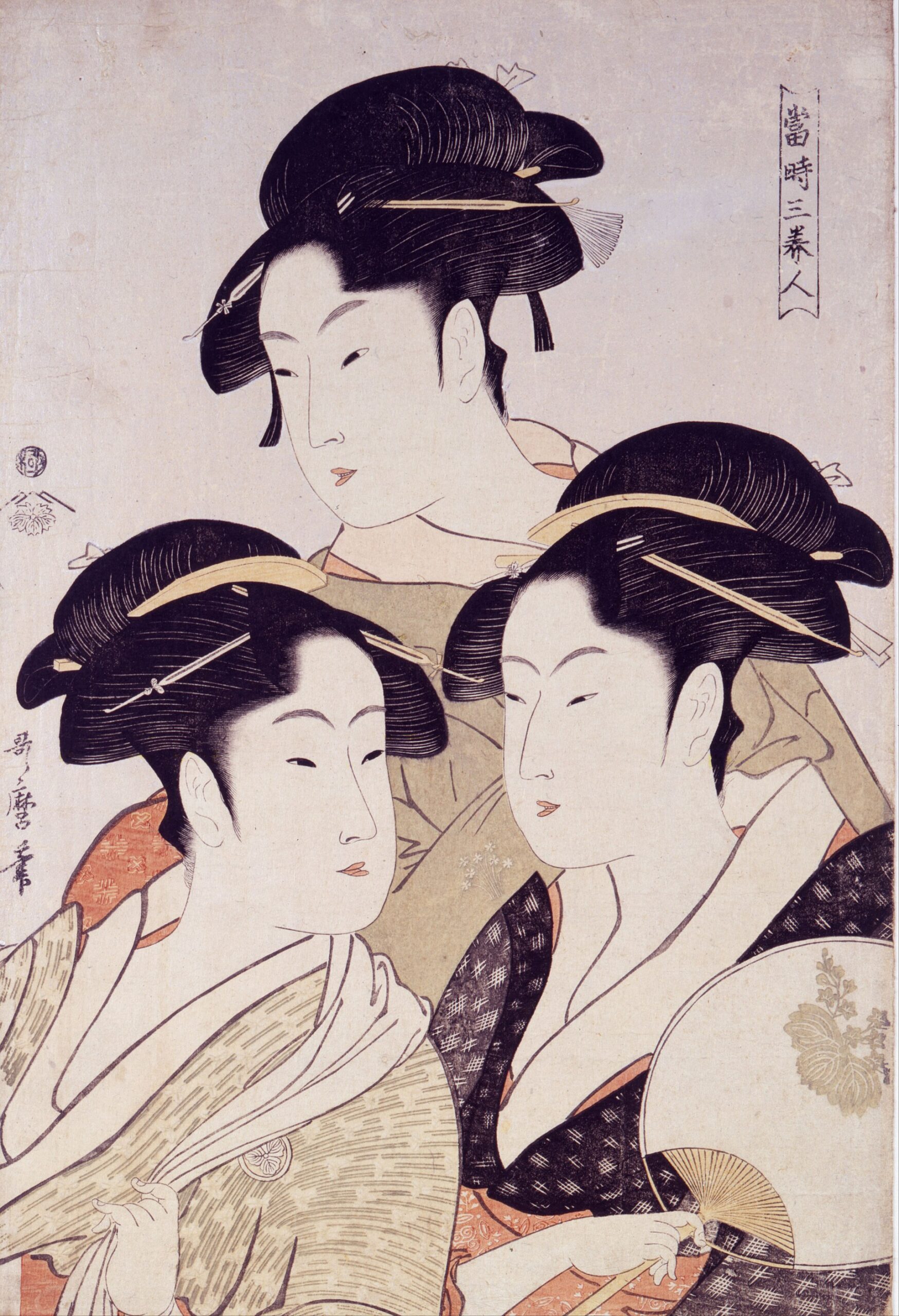
The Edo period is where the story gets properly human. The shogunate ran a hereditary four tier order with samurai at the top and merchants at the bottom, and yet the merchants were the ones making money. So it legislated. Sumptuary laws put expensive fabrics, certain colors, ornate embroidery, and gold and silver out of reach of the lower classes.
The response was one of the great quiet rebellions in clothing: the money went inward. Plain outer garments were lined with costly silk, and bold patterned cloth went into linings and undergarments where only the wearer knew. On the outside, style went into stripes and into more than a hundred variations of the permitted grays, browns and navy blues. The wide obi we think of as standard is an Edo development too, dating only from the eighteenth century.
How A Kimono Is Cut, And Why It Matters To You
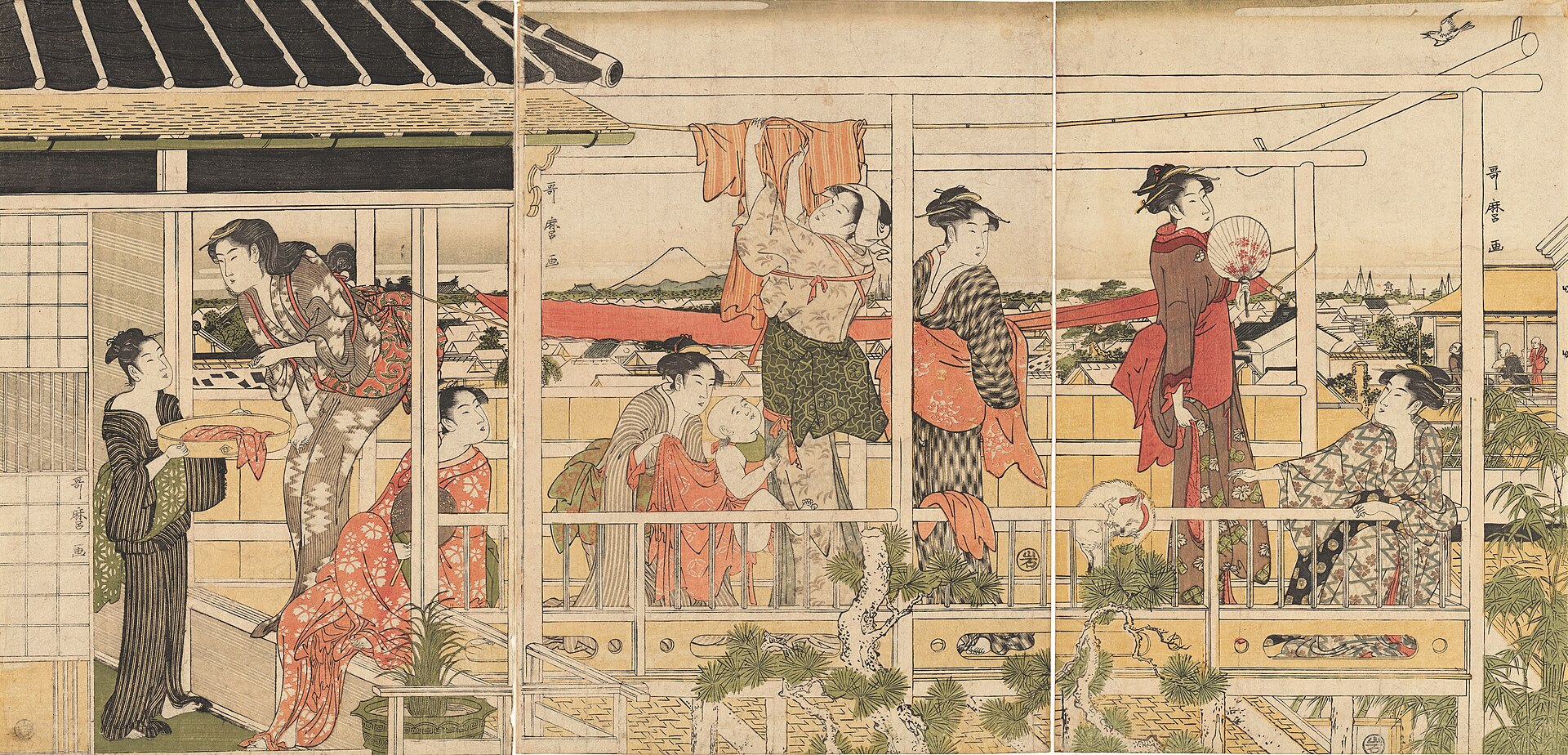
Here is the part worth pinning up over your cutting table. A kimono is made from a tanmono, a single narrow bolt woven for the purpose. A bolt for a woman runs roughly 38 to 41 centimeters wide and about 12.5 meters long, and it is divided into eight pieces. Every one of them is a rectangle. No curved armhole, no bust dart, no shaped side seam, and almost nothing left over.
Fit is not built in either. The Victoria and Albert Museum describes the kimono as a long straight cut garment with wide sleeves set at right angles, and it has no fastenings of its own. It is wrapped closely round the hips, always left side over right, the surplus length folded away in a tuck at the waist and held by the obi. Length is adjusted under the sash, so one garment can genuinely fit more than one person.
Then there is the sewing. Kimono are traditionally hand stitched with long straight seams, and that is deliberate. In the process called arai hari the garment is unpicked completely, back to flat rectangular panels. The panels are washed, historically in a shallow river, stretched on a board or on bamboo rods held with wooden clamps so they dry flat, and then sewn up again. Machine stitching does not come apart kindly. Hand stitching does, so it is worth learning your hand sewing stitches.
Set that against the way most of us cut a bodice, with pieces nested at odd angles and a bag of scraps at the end. Zero waste cutting is talked about now as a modern idea. It is not. It is what happens when cloth is precious and the loom is narrow.
Meiji Japan Puts On Western Clothes
From 1868 the Meiji government set about modernizing in public. Western dress was permitted for government bureaucrats in 1871, and in 1872 the Emperor cut off his topknot and appeared in Western clothing. The Empress followed in 1886.
But an edict aimed at officials is not a change in what a country wears. Ordinary people, and women in particular, went on wearing Japanese dress, and by the 1890s the kimono had reasserted itself as the primary dress of the Japanese people.
Traditional Japanese Clothing Today

The everyday kimono is largely gone. Most people in Japan now wear one for weddings, funerals and shrine visits, Coming of Age Day among them, and many rent rather than buy.
That is not the whole picture though. A younger generation has been picking the kimono back up and treating it as clothing rather than costume. They wear it to theme parks and at Halloween, and try it in tweed or denim. The designer YOSHIKI has made kimono carrying anime imagery and argues for breaking out of fixed ideas about how a kimono should be worn. If you want to read further, there are some good books on the history of the kimono.
Conclusion
I came to this expecting decoration and found engineering. The lesson is not about motifs or silk. It is that you can make a beautiful, comfortable, adjustable garment out of nothing but rectangles, and that if you sew it by hand you can take it apart later and give it another life.
Try it in small ways. Cut a simple wrap top from straight pieces and let a sash do the fitting. Sew one seam by hand and see how kindly it unpicks.
We have looked at folk dress elsewhere too: the traditional dresses of Spain, the traditional dresses of France, and traditional German dresses.
When you are ready to make something in this shape, start with our roundup of free kimono sewing patterns. There is a boho kimono dress, a kimono top and a baby kimono onesie in there too.
Some links above are Amazon affiliate links. As an Amazon Associate, So Sew Easy earns from qualifying purchases at no cost to you.
What about the poor people and Boro and sashiko? Please do a piece on these.
Thanks Christine, great suggestion. We’ve noted boro for a future post. In the meantime you might enjoy our sashiko tutorial: https://so-sew-easy.com/sashiko-quilting-tutorial-japanese-embroidery/